
 EN
EN
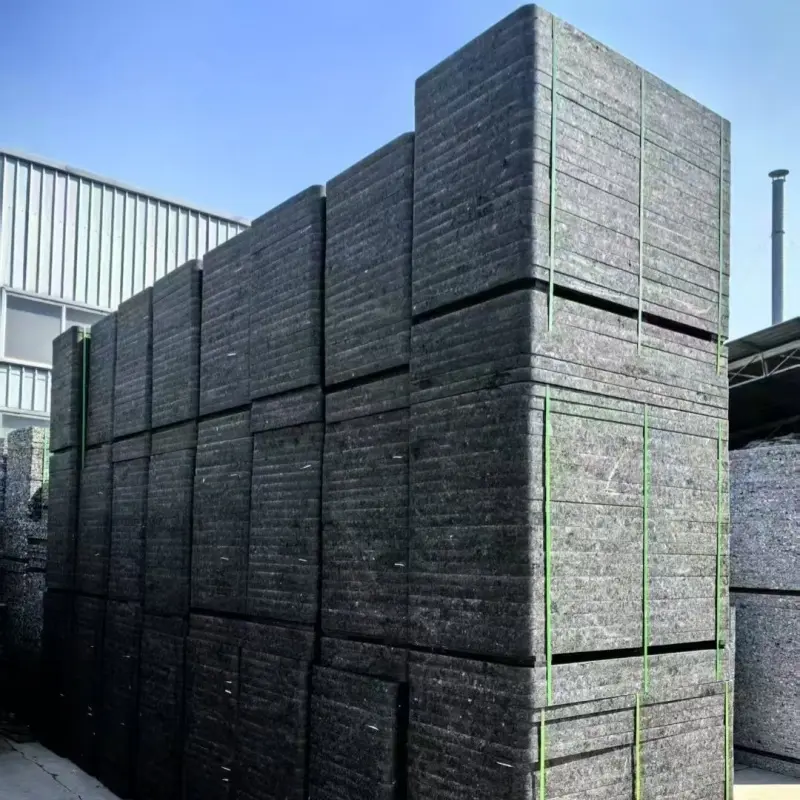
How GMT Pallet Thickness Affects Mechanical Performance in Brick Pallets
Stiffness, Load-Bearing Capacity, and Deflection Behavior vs. Thickness
GMT pallet thickness directly governs flexural rigidity and load-support capability—critical factors when handling stacks of fired bricks that impose high static pressures and concentrated point loads. A thicker cross-section increases the moment of inertia (I ∝ t³), significantly reducing deflection under identical loading conditions. For example, increasing thickness from 6 mm to 10 mm—while holding fiber volume and orientation constant—can reduce mid-span deflection by approximately 40%. Load-bearing capacity rises nearly linearly with thickness in the lower range, but this relationship plateaus as failure modes shift from flexural yielding toward interlaminar shear at greater thicknesses. Designers targeting a specific deflection limit—such as L/360 under full brick load—must therefore select thickness deliberately: sufficient to meet stiffness requirements, yet lean enough to avoid unnecessary weight and material cost.
Empirical Thresholds: When Increasing Thickness Yields Diminishing Returns (e.g., Beyond 12 mm)
Testing data from real-world composite pallet applications shows that mechanical gains diminish sharply beyond ~12 mm thickness for standard brick-handling use cases. A 14 mm pallet delivers only marginal improvements in stiffness or load capacity over a 12 mm version—yet consumes nearly 17% more material. This inefficiency stems from practical limits on theoretical scaling: although bending stiffness grows with the cube of thickness, thicker GMT laminates experience increased shear deformation and interfacial debonding between plies, reducing effective section modulus. As a result, specifying thickness beyond 12 mm typically adds cost and mass without proportional structural benefit. Engineers seeking higher performance should instead prioritize design optimizations—such as rib integration, strategic fiber alignment, or tailored wall geometry—to improve structural efficiency without over-thickening.
Critical Application Drivers for Brick Pallet Thickness Selection
High-Cycle Automated Warehousing with Heavy Brick Loads
In automated warehousing environments, brick pallets undergo thousands of pick-and-place cycles under dynamic loads often exceeding 1,000 kg. Thickness is decisive in resisting permanent deformation and fatigue cracking: pallets under 10 mm risk progressive bowing or warping, which can jam conveyors and robotic handlers. A thickness of 12–14 mm provides the dimensional stability needed to sustain ≥10,000 cycles without measurable loss of flatness or load-bearing integrity. Thinner variants may meet initial strength thresholds but tend to fail prematurely under cyclic stress—increasing downtime, maintenance frequency, and total cost of ownership.
Thermal Cycling Environments: Thickness as a Stability Control Factor
Brick manufacturing and storage expose pallets to wide thermal swings—from kiln-adjacent zones (80–120°C) to refrigerated staging areas (0–10°C). Thicker GMT pallets (≥12 mm) respond more uniformly to thermal expansion and contraction, minimizing warpage and micro-cracking risks. In contrast, thinner pallets (≤8 mm) are prone to buckling or localized distortion under repeated thermal stress, compromising brick support uniformity and potentially damaging product edges. Adequate thickness thus serves not only as a mechanical safeguard but also as a thermal stability control—extending service life and preserving pallet flatness across variable operating conditions.
Complementary Design Elements That Interact with Thickness in Brick Pallets
Ribs, Fiber Orientation, and Wall Geometry: Enhancing Structural Efficiency Without Over-Thickening
Thickness alone does not define structural performance—its effectiveness is amplified or constrained by integrated design features. Strategically placed ribs can increase global stiffness by up to 40% without adding material mass, effectively lowering deflection under heavy brick loads. During GMT molding, aligning glass fibers along principal stress directions—notably parallel to beam-like spans—boosts bending resistance by 20–30% compared to random orientation. Similarly, engineered wall geometries—such as corrugated, trapezoidal, or honeycomb profiles—improve stress distribution and suppress localized buckling. These elements interact synergistically with thickness: a 10 mm pallet with optimized ribs and aligned fibers can match or exceed the rigidity and fatigue life of a solid 14 mm counterpart. By leveraging such complementary strategies, engineers routinely achieve target performance at 12 mm or less—reducing material use, cycle time, and overall system weight while maintaining automation-grade reliability.
Practical Engineering Guidelines for Specifying GMT Thickness in Brick Pallet Projects
Begin thickness specification by aligning mechanical targets with actual operational demands—not theoretical maxima. For automated warehouses handling heavy brick loads, a range of 8–12 mm offers the optimal balance: sufficient dynamic load capacity (≥1,500 kg) and deflection control, while avoiding premature fatigue failure in high-cycle scenarios. In thermally variable settings, apply localized thickness increases—15–20% near edge supports—to manage differential expansion stresses, while using central ribbing to preserve lightweight efficiency. Crucially, validate designs via FEA to map stress concentrations and avoid crossing the 12 mm threshold unnecessarily; material costs rise 18–22% per millimeter beyond this point, with negligible returns in stiffness or durability. Always pair thickness decisions with functional enhancements—cross-rib patterns aligned to principal stress vectors, hybrid wall geometries, and controlled fiber orientation—to hit required stiffness metrics while minimizing total material volume and lifecycle cost.
FAQ Section
What is the ideal thickness for GMT brick pallets?
The ideal thickness for GMT brick pallets depends on the application. In high-cycle automated warehousing, 12–14 mm is optimal, while 8–12 mm suffices for lighter applications.
Why does increasing thickness beyond 12 mm yield diminishing returns?
After 12 mm, mechanical gains plateau due to increased shear deformation and interfacial debonding, making additional material inefficient for most applications.
How can engineers achieve higher performance without increasing thickness?
Engineers can enhance performance by incorporating ribs, aligning fibers strategically, and using optimized wall geometries, which improve structural efficiency while minimizing material use.
How does GMT pallet thickness affect thermal stability?
Thicker GMT pallets (≥12 mm) resist warping and micro-cracking under thermal cycling better than thinner alternatives, ensuring longevity in variable temperature environments.
What are the cost implications of exceeding the 12 mm thickness threshold?
Material costs increase by 18–22% per additional millimeter beyond 12 mm, with negligible improvement in performance.
Table of Contents
- How GMT Pallet Thickness Affects Mechanical Performance in Brick Pallets
- Critical Application Drivers for Brick Pallet Thickness Selection
- Complementary Design Elements That Interact with Thickness in Brick Pallets
- Practical Engineering Guidelines for Specifying GMT Thickness in Brick Pallet Projects
-
FAQ Section
- What is the ideal thickness for GMT brick pallets?
- Why does increasing thickness beyond 12 mm yield diminishing returns?
- How can engineers achieve higher performance without increasing thickness?
- How does GMT pallet thickness affect thermal stability?
- What are the cost implications of exceeding the 12 mm thickness threshold?