
 EN
EN
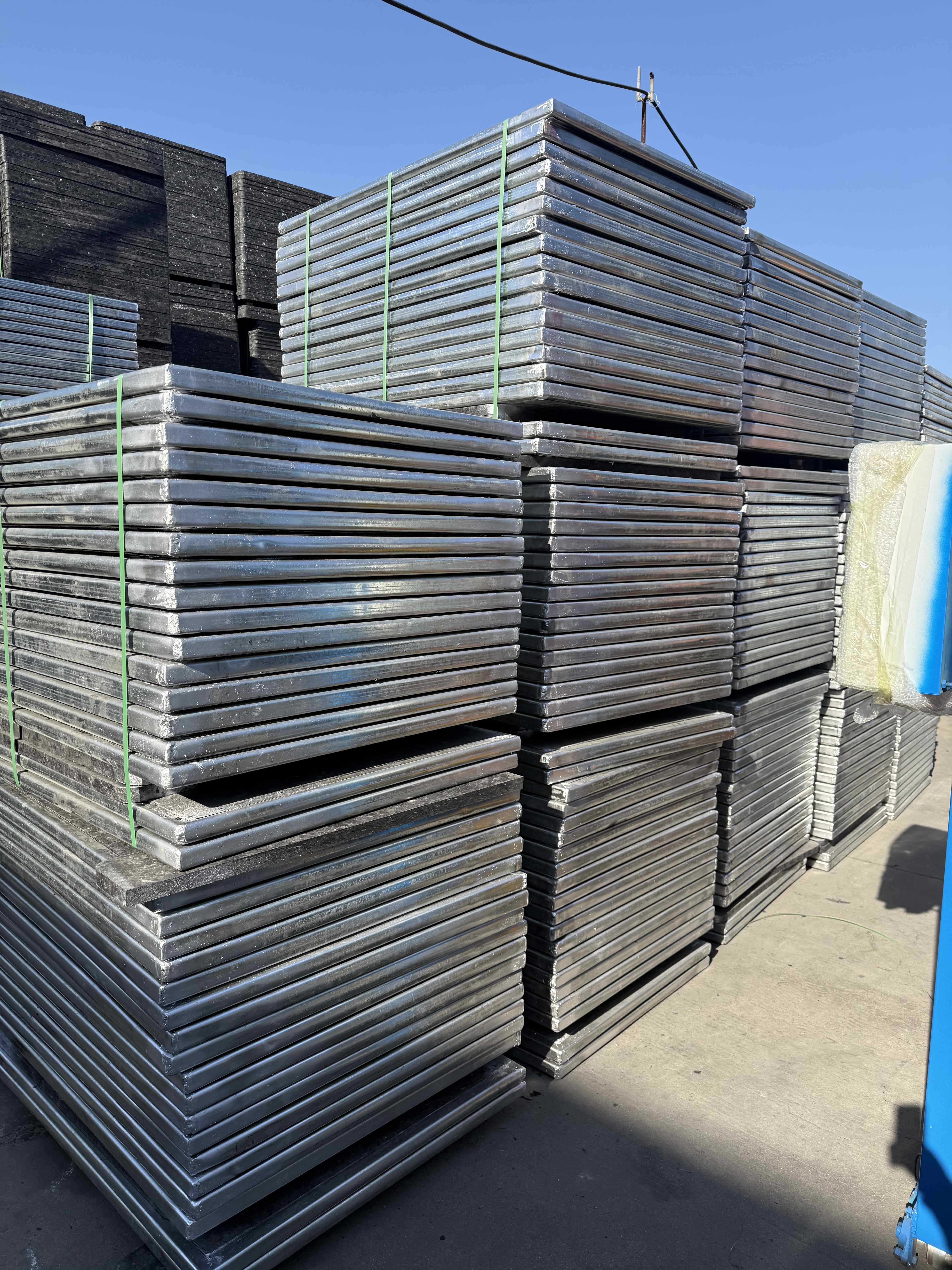
Unmatched Structural Integrity for Automated Block Lines
High-Failure Rates of Conventional Pallets in High-Cycle Production
Automated block lines demand pallets that withstand repeated high-speed handling, heavy loads, and sustained vibration. Conventional wood, PVC, and bamboo pallets consistently fail under these conditions. Wood absorbs moisture, leading to warping, splitting, and dimensional drift. PVC becomes brittle with thermal cycling, while bamboo suffers delamination and edge chipping after repeated impact. Industry data show up to 15% of these pallets fail within the first 500 production cycles—triggering costly stoppages and damaging finished blocks. The root cause is inherent material limitations: none offer the fatigue resistance or dimensional stability required for high-cycle manufacturing.
How 3D Glass Fiber Reinforcement and Thermoplastic Matrix Resist Fatigue and Deformation
GMT (Glass Mat Thermoplastic) brick pallets solve these issues at the material level. Their 3D glass fiber reinforcement distributes stress uniformly across the structure, eliminating localized stress points that lead to cracking and fatigue failure. Unlike 2D woven or chopped strand mats, this three-dimensional architecture resists multi-directional impact—critical during robotic stacking and conveyor transfer. The polypropylene thermoplastic matrix adds controlled elasticity: the pallet flexes slightly under load and fully recovers its shape without permanent deformation. Tensile strength remains stable across thousands of cycles—even under repeated exposure to curing steam—and creep resistance prevents slow sagging under stacked static loads. As a result, GMT pallets retain flatness and dimensional accuracy throughout service life, directly supporting consistent block quality and uninterrupted automated production.
Heavy-Duty Load Capacity: Static Strength and Dynamic Impact Resistance
Real-World Dynamic Load Performance vs. Wood, PVC, and Bamboo Brick Pallets
In automated block production, dynamic shock—not just static weight—drives pallet failure. Wood splinters on impact; PVC softens and deforms in high-temperature curing zones; bamboo cracks after only a few hundred cycles. By contrast, the composite structure of GMT brick pallets absorbs kinetic energy without yielding, delivering over 5,000 verified impact cycles without structural compromise. This resilience translates directly into fewer line stoppages, reduced pallet replacement frequency, and lower long-term operational costs for manufacturers requiring continuous, high-throughput output.
Design Optimization: Rib Geometry and Thickness for 3,500 kg Static / 1,800 kg Dynamic Loads
These load ratings stem from engineering precision—not just material choice. Finite element analysis guides rib geometry: deep, cross-hatched ribs distribute static weight evenly across the deck, while thickened perimeter beams resist torsional stress during robotic handling and tilt-table transfers. The result is a platform rated for 3,500 kg stationary and 1,800 kg under dynamic conveyor or robotic motion—without stress concentration points that accelerate failure in molded-wood or PVC alternatives. This optimized design ensures rated capacity remains consistent even after years of heavy-duty use.
Corrosion Resistance and Lifecycle Economics of GMT Brick Pallets
Humidity, Curing Steam, and Chemical Exposure: Why Corrosion Resistance Is Critical
Block plants subject pallets to a uniquely aggressive environment: moisture from wet concrete, saturated curing steam (often exceeding 95% RH), and alkaline chemical additives like cement accelerators. Steel rusts and stains blocks; wood and bamboo swell, warp, and degrade biologically—introducing variability that disrupts automated handling and causes jams. GMT pallets avoid these pitfalls entirely. Their thermoplastic resin matrix is chemically inert, forming an impermeable barrier against water absorption and resisting alkalis, chlorides, and other common plant contaminants. This ensures long-term flatness and dimensional consistency—key prerequisites for reliable automation.
42% Lower Total Cost of Ownership vs. Bamboo Pallets Over 18 Months
Lifecycle economics confirm what performance testing reveals: GMT pallets deliver superior value. While bamboo pallets carry a lower upfront price, their typical service life under high-cycle steam curing is just 6–8 months—necessitating frequent replacements, increasing downtime, and raising labor and logistics costs. A comprehensive 18-month TCO analysis shows GMT pallets reduce total cost of ownership by 42%, factoring in replacement frequency, maintenance, downtime, and scrap reduction. With a theoretical service life of up to eight years in optimal conditions, GMT pallets significantly lower cost per block produced—making them the economically rational choice for modern, automated block manufacturing.
Seamless Compatibility with Automated Block Manufacturing Equipment
Modern automatic block machines require precise dimensional tolerances and surface flatness—both non-negotiable for PLC-controlled handling. GMT brick pallets are injection-molded to exact specifications, ensuring consistent height, deck flatness, and corner radii across every unit. The rigid, thermally stable thermoplastic matrix resists warping through repeated thermal cycling, preserving alignment across thousands of curing cycles. Low moisture absorption and tightly controlled weight distribution eliminate variability that confuses grippers, conveyors, and stackers. As a result, GMT pallets integrate seamlessly into existing automated systems—no retrofitting, no recalibration, and no commissioning delays—supporting maximum throughput from day one.
FAQs
What are the common failure causes of conventional pallets in automated block production?
Conventional pallets such as wood, PVC, and bamboo fail primarily due to moisture absorption, warping, cracking, or becoming brittle under repeated mechanical and thermal stress.
How do GMT pallets achieve superior fatigue resistance?
GMT pallets utilize 3D glass fiber reinforcement and a thermoplastic matrix, distributing stress uniformly and resisting deformation across thousands of production cycles.
What is the weight capacity of GMT pallets?
GMT pallets are engineered to support 3,500 kg of static weight and 1,800 kg of dynamic load, ensuring reliable performance under heavy-duty conditions.
Why are GMT pallets more cost-effective than bamboo pallets?
Although bamboo pallets have a lower upfront cost, their shorter service life and frequent replacements lead to higher operational costs. GMT pallets reduce total cost of ownership by up to 42% over 18 months.
Are GMT pallets compatible with automated block manufacturing equipment?
Yes, GMT pallets are designed with precise tolerances, ensuring seamless integration with modern automated systems, without requiring retrofitting or adjustments.
Table of Contents
- Unmatched Structural Integrity for Automated Block Lines
- Heavy-Duty Load Capacity: Static Strength and Dynamic Impact Resistance
- Corrosion Resistance and Lifecycle Economics of GMT Brick Pallets
- Seamless Compatibility with Automated Block Manufacturing Equipment
-
FAQs
- What are the common failure causes of conventional pallets in automated block production?
- How do GMT pallets achieve superior fatigue resistance?
- What is the weight capacity of GMT pallets?
- Why are GMT pallets more cost-effective than bamboo pallets?
- Are GMT pallets compatible with automated block manufacturing equipment?